Artworks presented at 99 years
curated by Warren Wee
19 to 26 January 2026 •Tiong Bahru Air Raid Shelter
curated by Warren Wee
19 to 26 January 2026 •Tiong Bahru Air Raid Shelter
© Bianca Tse
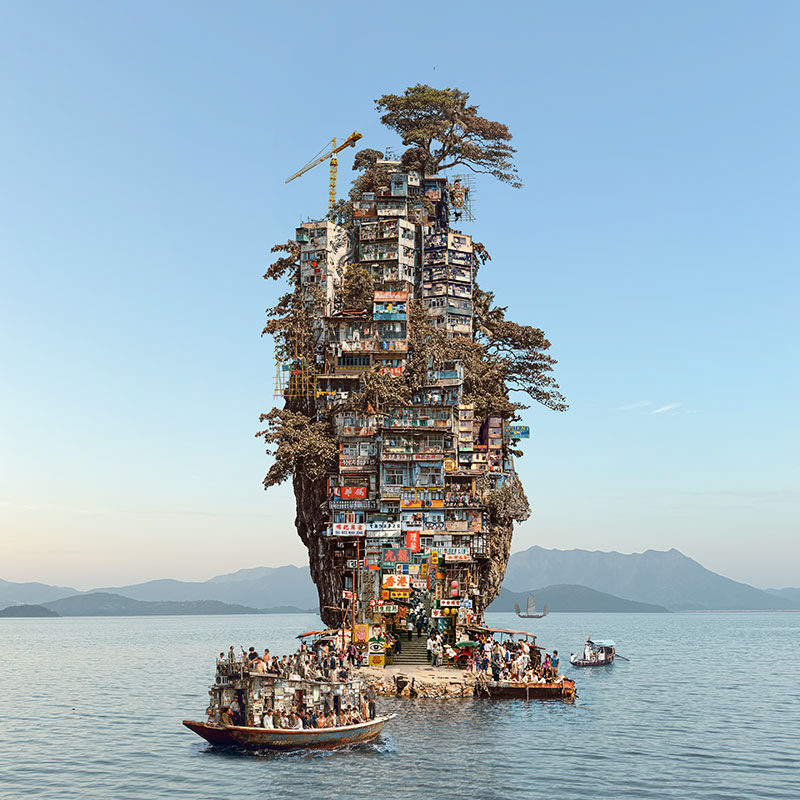
Pong Lai 蓬萊 (2026)
By Bianca Tse
Single-channel AI video, 2 minutes 1 second
蓬萊 Pong Lai — a mythological paradise meant to be unreachable. Yet, this artwork presents a different kind of paradise: one that is desperately, violently, and beautifully constructed by mortal hands against the tides of history. This island is not geologically formed; it is anthropologically accumulated. It traces the waves of refugees who arrived to build this island, stacking their lives precariously in search of sanctuary. It is a vertical timeline of a city built on the transient promises of a "dream home".
The artist reimagines her hometown - Hong Kong - not as a city, but as a living sediment of memory. This structure explores the frantic era of building on borrowed time and leased land. It reveals that this metropolis is no floating mirage; it rests heavily on a mountain of survival. It is a temporary paradise constructed against a ticking clock, proving our future is forever held up by the dense layers of our past.
By Bianca Tse
Single-channel AI video, 2 minutes 1 second
蓬萊 Pong Lai — a mythological paradise meant to be unreachable. Yet, this artwork presents a different kind of paradise: one that is desperately, violently, and beautifully constructed by mortal hands against the tides of history. This island is not geologically formed; it is anthropologically accumulated. It traces the waves of refugees who arrived to build this island, stacking their lives precariously in search of sanctuary. It is a vertical timeline of a city built on the transient promises of a "dream home".
The artist reimagines her hometown - Hong Kong - not as a city, but as a living sediment of memory. This structure explores the frantic era of building on borrowed time and leased land. It reveals that this metropolis is no floating mirage; it rests heavily on a mountain of survival. It is a temporary paradise constructed against a ticking clock, proving our future is forever held up by the dense layers of our past.
© Boedi Widjaja
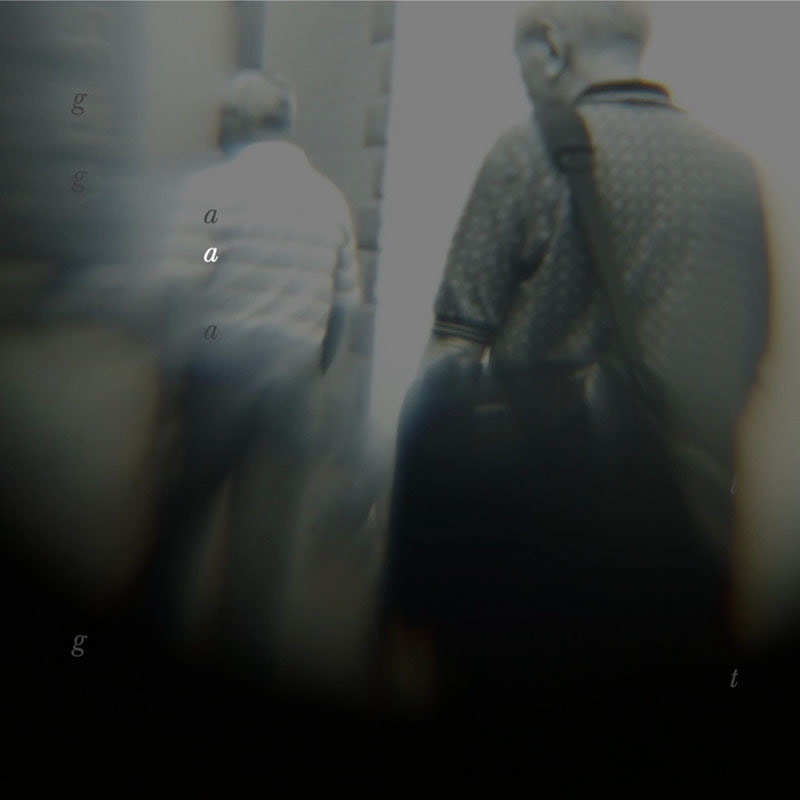
A Tree Rings, A Tree Sings 树龄°述铃 (2021)
By Boedi Widjaja
Single-channel video, 20 minutes 58 seconds
A Tree Rings, A Tree Sings 树龄°述铃 is a video work made in collaboration with Eric Yap, Associate Professor, Human and Microbial Genetics at the Lee Kong Chian School of Medicine in Singapore. New findings in epigenetics suggest that we inherit ancestral memories. Could we then possibly inherit images and sounds–audiovisual signals–through genetic transmissions? In 2012, the artist returned to his grandfather’s hometown and snapped 700 photos in 5 days. In 2021, the artist re-photographed them into moving images through an analogue process that he had devised, involving constant manipulation of inverted camera lenses. The video soundtrack uses inverted gamelan sounds, a metallophone instrument from Indonesia; and the music score is a hybrid DNA code - a chimaera of person, plant and poetry. The video is generative, an algorithmic composition that plays differently every time, and almost infinitely.
Path. 17, Arus Balik (2026)
By Boedi Widjaja
Chalk, synthetic DNA, stencils and petri dishes, site specific
Path. 17, Arus Balik is a site-responsive, multimodal work exploring how collective gestures, through intertwined acts of remembering and forgetting, animate historical currents. Drawing from Pramoedya Ananta Toer’s historical novel Arus Balik (“Waves Return”), the project engages with the loops of history as if they were strands of inherited code: sequences that duplicate, mutate, or degrade. Here, marking and erasure operate as complementary actions of memory, surfacing the fluctuation of histories across bodies, space, and time. The work comprises two interconnected components, creating a dialogue between inscription and erasure, body and inheritable code, collective gestures and sequence.
By Boedi Widjaja
Single-channel video, 20 minutes 58 seconds
A Tree Rings, A Tree Sings 树龄°述铃 is a video work made in collaboration with Eric Yap, Associate Professor, Human and Microbial Genetics at the Lee Kong Chian School of Medicine in Singapore. New findings in epigenetics suggest that we inherit ancestral memories. Could we then possibly inherit images and sounds–audiovisual signals–through genetic transmissions? In 2012, the artist returned to his grandfather’s hometown and snapped 700 photos in 5 days. In 2021, the artist re-photographed them into moving images through an analogue process that he had devised, involving constant manipulation of inverted camera lenses. The video soundtrack uses inverted gamelan sounds, a metallophone instrument from Indonesia; and the music score is a hybrid DNA code - a chimaera of person, plant and poetry. The video is generative, an algorithmic composition that plays differently every time, and almost infinitely.
Path. 17, Arus Balik (2026)
By Boedi Widjaja
Chalk, synthetic DNA, stencils and petri dishes, site specific
Path. 17, Arus Balik is a site-responsive, multimodal work exploring how collective gestures, through intertwined acts of remembering and forgetting, animate historical currents. Drawing from Pramoedya Ananta Toer’s historical novel Arus Balik (“Waves Return”), the project engages with the loops of history as if they were strands of inherited code: sequences that duplicate, mutate, or degrade. Here, marking and erasure operate as complementary actions of memory, surfacing the fluctuation of histories across bodies, space, and time. The work comprises two interconnected components, creating a dialogue between inscription and erasure, body and inheritable code, collective gestures and sequence.
© Goh Chun Aik
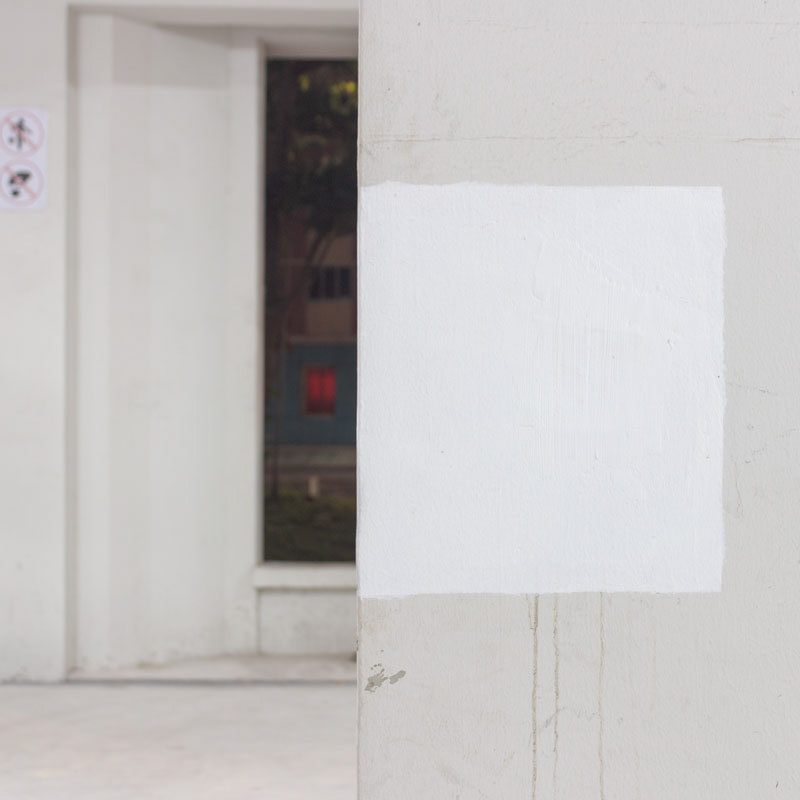
The Meaning of White 4 (2020/2023)
By Goh Chun Aik
Photography
The Meaning of White is a series of photos taken in public spaces, where a coat of fresh white paint has been applied onto walls and pillars, possibly to erase vandalism on the walls. The fresh paint contrasts against the aged walls, creating intrigue and prompting contemplation upon what lies beneath these blocks of white on white. When the artist chanced upon these curious patches, he began to imagine the possibility of viewing them as artworks in their own right; paintings by Rothko, Malevich, Ryman, and more came up in his mind. What were the intended messages of the original forbidden works, and what thoughts might the act of painting over works have prompted? The artist could not help but wonder how intentions, functions, forms, colours, and the environment come together to define our perceptions and prescriptions of value and legitimacy to what we see around us.
By Goh Chun Aik
Photography
The Meaning of White is a series of photos taken in public spaces, where a coat of fresh white paint has been applied onto walls and pillars, possibly to erase vandalism on the walls. The fresh paint contrasts against the aged walls, creating intrigue and prompting contemplation upon what lies beneath these blocks of white on white. When the artist chanced upon these curious patches, he began to imagine the possibility of viewing them as artworks in their own right; paintings by Rothko, Malevich, Ryman, and more came up in his mind. What were the intended messages of the original forbidden works, and what thoughts might the act of painting over works have prompted? The artist could not help but wonder how intentions, functions, forms, colours, and the environment come together to define our perceptions and prescriptions of value and legitimacy to what we see around us.
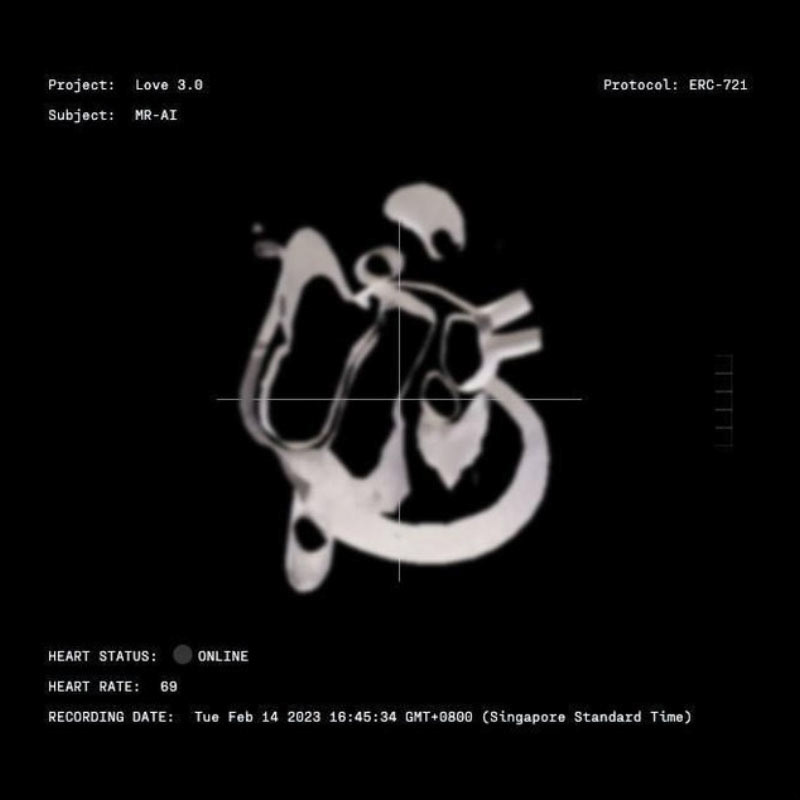
© Jake Tan
MR(AI) (2023)
By Jake Tan
Dynamic NFT
MR(AI) is a work where love is decontructed to a more primal level, MR(AI) takes a transparent approach to the relationship between data and love. Reacting to the Artist, Jake Tan’s real-time heart rate, the artwork pulsates according to the data received. Mimicking an MRI scan, MR(AI) borrows the concept that an MRI Scanner is nothing more than a perspective into one's heart, questioning what it means to have a peek into one's heart in the age of data collection and machine learning.
DATA-ST0RM (2026)
By Jake Tan
site specific
DATA-ST0RM is a site-specific artefact in the Tiong Bahru Air Raid Shelter that responds to air stillness and the shifts caused when people pass nearby. A looping sky image holds steady until movement disturbs the space, triggering moments of visual rupture where the image smears, tears, and melts. The work draws attention to what usually goes unregistered, the air that holds history and the air that changes when we arrive. Wind is treated as paradox, always there, always not, sensed through its effects. Stillness is framed as presence rather than absence, and the work unfolds on a bodily timescale where the air resets, holds, and is disturbed again, over and over. In this repeating cycle, DATA-ST0RM offers a temporality of eternity, endurance as recurrence, not permanence.
By Jake Tan
Dynamic NFT
MR(AI) is a work where love is decontructed to a more primal level, MR(AI) takes a transparent approach to the relationship between data and love. Reacting to the Artist, Jake Tan’s real-time heart rate, the artwork pulsates according to the data received. Mimicking an MRI scan, MR(AI) borrows the concept that an MRI Scanner is nothing more than a perspective into one's heart, questioning what it means to have a peek into one's heart in the age of data collection and machine learning.
DATA-ST0RM (2026)
By Jake Tan
site specific
DATA-ST0RM is a site-specific artefact in the Tiong Bahru Air Raid Shelter that responds to air stillness and the shifts caused when people pass nearby. A looping sky image holds steady until movement disturbs the space, triggering moments of visual rupture where the image smears, tears, and melts. The work draws attention to what usually goes unregistered, the air that holds history and the air that changes when we arrive. Wind is treated as paradox, always there, always not, sensed through its effects. Stillness is framed as presence rather than absence, and the work unfolds on a bodily timescale where the air resets, holds, and is disturbed again, over and over. In this repeating cycle, DATA-ST0RM offers a temporality of eternity, endurance as recurrence, not permanence.
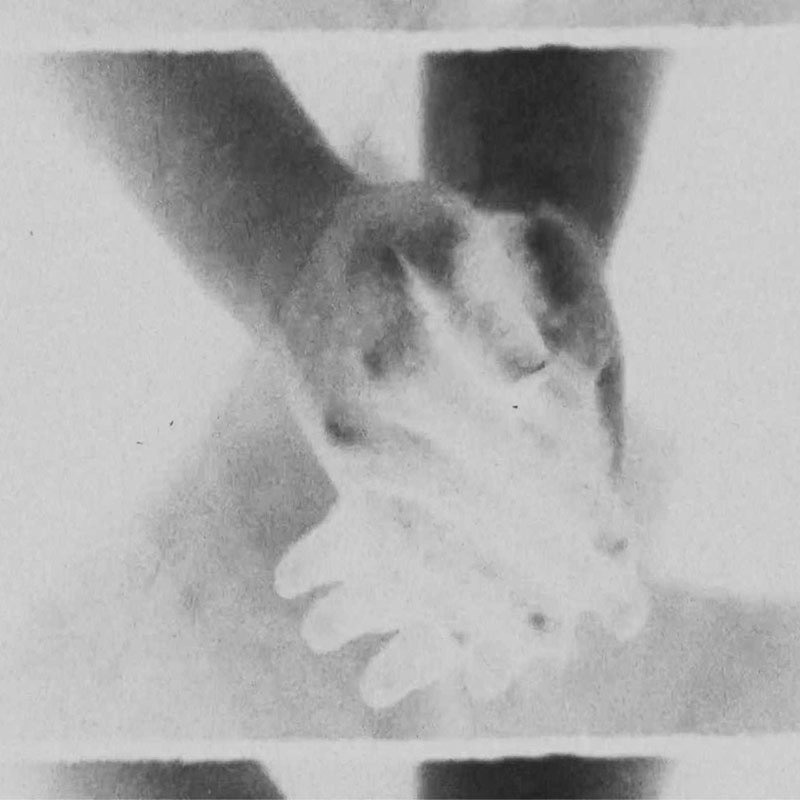
© JinJin Xu
Testimony: Tiong Bahru (2026)
By JinJin Xu
Metal basin, water, video projection, site specific
The air raid shelter is activated into a space of ritual through the installation of metal basins— akin to those used in makeshift medical tents in war-time environments— teeming with “digital” water. The water is haunted by ghostly projections that create an illusion that the now abandoned shelter is alive with specters of the past.
By JinJin Xu
Metal basin, water, video projection, site specific
The air raid shelter is activated into a space of ritual through the installation of metal basins— akin to those used in makeshift medical tents in war-time environments— teeming with “digital” water. The water is haunted by ghostly projections that create an illusion that the now abandoned shelter is alive with specters of the past.
Hegel writes, “The owl of Minerva takes flight only at dusk.” Time is non-linear; history is unresolved and ever-present. “Testimony: Tiong Bahru”—the third in the site-specific “TESTIMONY” series by Shanghai and New York-based artist JinJin Xu interrogating the erasure of personal & collective memory—combines installation, projection, and sound to create a threshold between this world and the next.
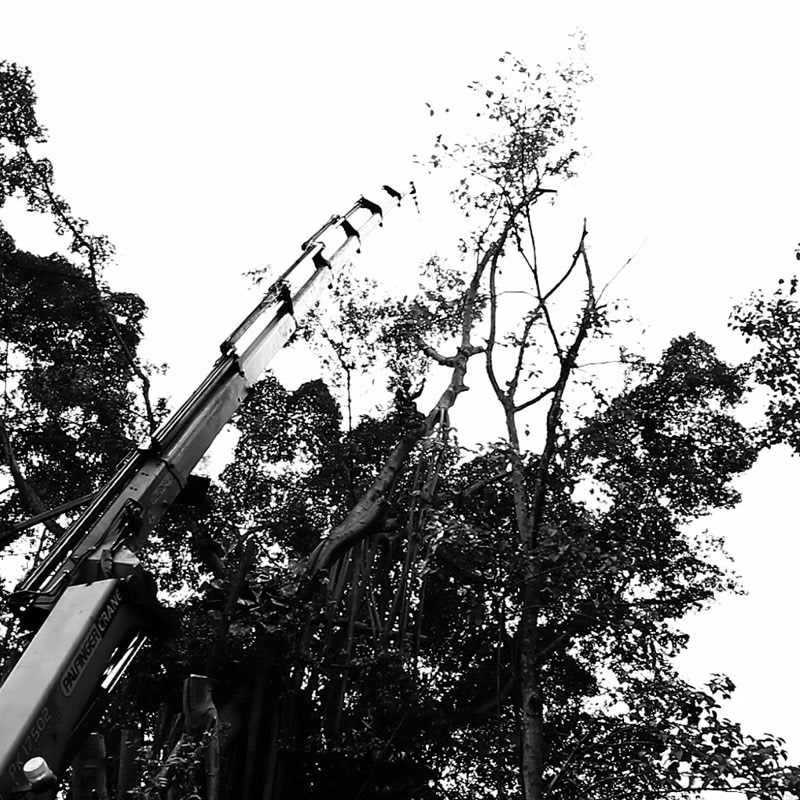
© Robert Zhao Renhui
This Tree We Must Save and Other Stories (2024)
By Robert Zhao Renhui
Single-channel video, 23 minutes 17 seconds
The artist revisits the decade-old footage of the Substation Banyan tree being cut down to create a new video work “This Tree We Must Save, and Other Stories”. Ten years after the tree was transplanted, the artist remains conflicted about the episode as he juxtaposes recordings of the tree being cut with timelapse of a growing secondary forest. Words are weaved into the video as the artist contemplates upon the binary perspective of humanity’s actions and their consequences towards nature, seeking to consider alternative ways of thinking about our relationship with nature.
By Robert Zhao Renhui
Single-channel video, 23 minutes 17 seconds
The artist revisits the decade-old footage of the Substation Banyan tree being cut down to create a new video work “This Tree We Must Save, and Other Stories”. Ten years after the tree was transplanted, the artist remains conflicted about the episode as he juxtaposes recordings of the tree being cut with timelapse of a growing secondary forest. Words are weaved into the video as the artist contemplates upon the binary perspective of humanity’s actions and their consequences towards nature, seeking to consider alternative ways of thinking about our relationship with nature.
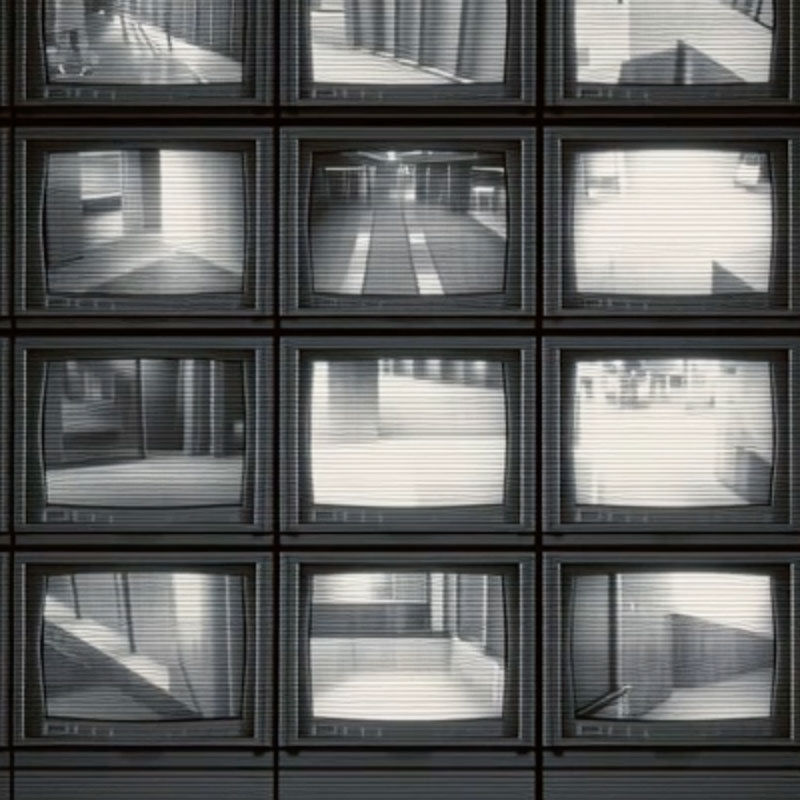
© Samantha Lee
Was this you? (2026)
By Samantha Lee
Two-channel video, iPhone, phone display, projection, participatory synthetic video engine, site specific
Lying in a bed that is not quite their own, the viewer becomes the protagonist of an Internet nightmare. On the bedside stand, a phone plays an endless loop of login warnings and security prompts – new sign-in from unknown device, suspicious activity detected, was this you? – a familiar grammar of digital anxiety. Behind the bed, a large projection shows surveillance-style footage: a deepfake synthetic imagery of the artist appears in scenes of crimes she did not commit, moving through a world full of uncanny valleys. was this you? stages the moment when your digital self starts acting beyond you. The installation borrows the intimacy of the bedroom – a site of scrolling, secrets, and sleepless spirals – and turning it into a theatre for a post-truth identity crisis. The viewer watches, prone and vulnerable, as interfaces and images renegotiate who they are. The piece looks past the immediate scandal of the deepfake toward a longer horizon of digital afterlives. Our shared images, voice notes, interviews, and posts will outlast our bodies; the Internet will continue to host versions of us we no longer recognise, or no longer have the power to correct. was this you? asks what it means to be memorialised by systems that can infinitely remix our likeness, and whether, in a world where anything can be generated, we will still trust what we see online – where does the authentic self end and its synthetic echo begin?
By Samantha Lee
Two-channel video, iPhone, phone display, projection, participatory synthetic video engine, site specific
Lying in a bed that is not quite their own, the viewer becomes the protagonist of an Internet nightmare. On the bedside stand, a phone plays an endless loop of login warnings and security prompts – new sign-in from unknown device, suspicious activity detected, was this you? – a familiar grammar of digital anxiety. Behind the bed, a large projection shows surveillance-style footage: a deepfake synthetic imagery of the artist appears in scenes of crimes she did not commit, moving through a world full of uncanny valleys. was this you? stages the moment when your digital self starts acting beyond you. The installation borrows the intimacy of the bedroom – a site of scrolling, secrets, and sleepless spirals – and turning it into a theatre for a post-truth identity crisis. The viewer watches, prone and vulnerable, as interfaces and images renegotiate who they are. The piece looks past the immediate scandal of the deepfake toward a longer horizon of digital afterlives. Our shared images, voice notes, interviews, and posts will outlast our bodies; the Internet will continue to host versions of us we no longer recognise, or no longer have the power to correct. was this you? asks what it means to be memorialised by systems that can infinitely remix our likeness, and whether, in a world where anything can be generated, we will still trust what we see online – where does the authentic self end and its synthetic echo begin?
© Sareena Sattapon
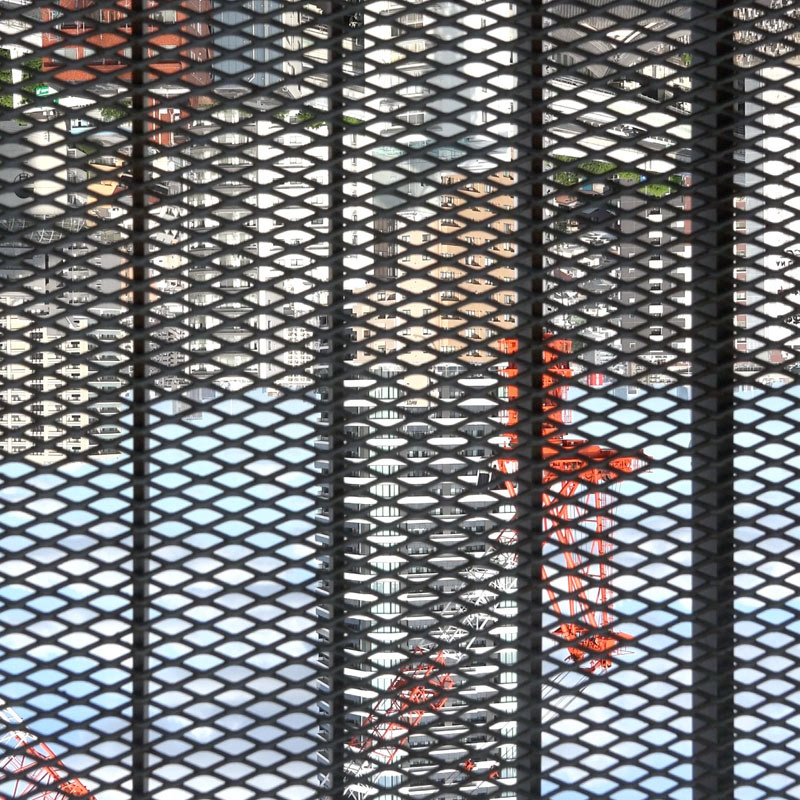
You and me and everyone we have met (2024)
By Sareena Sattapon
Single-channel video, 5 minutes
We often overlook the labor that keeps society moving, even when it’s right in front of us. This piece connects lives across backgrounds: from rural Thailand to urban Tokyo, through video and mirror that reflects ourselves, the things around us, and even the hidden aspects of society that we might have never noticed. In our society, there are many people who have been forgotten, especially the working class, who exist but are invisible. The work is an attempt to encourage people to pause, observe, and question the existence of people in society, as well as the meaning of their own existence in a constantly moving world.
By Sareena Sattapon
Single-channel video, 5 minutes
We often overlook the labor that keeps society moving, even when it’s right in front of us. This piece connects lives across backgrounds: from rural Thailand to urban Tokyo, through video and mirror that reflects ourselves, the things around us, and even the hidden aspects of society that we might have never noticed. In our society, there are many people who have been forgotten, especially the working class, who exist but are invisible. The work is an attempt to encourage people to pause, observe, and question the existence of people in society, as well as the meaning of their own existence in a constantly moving world.
© Seahee Chang
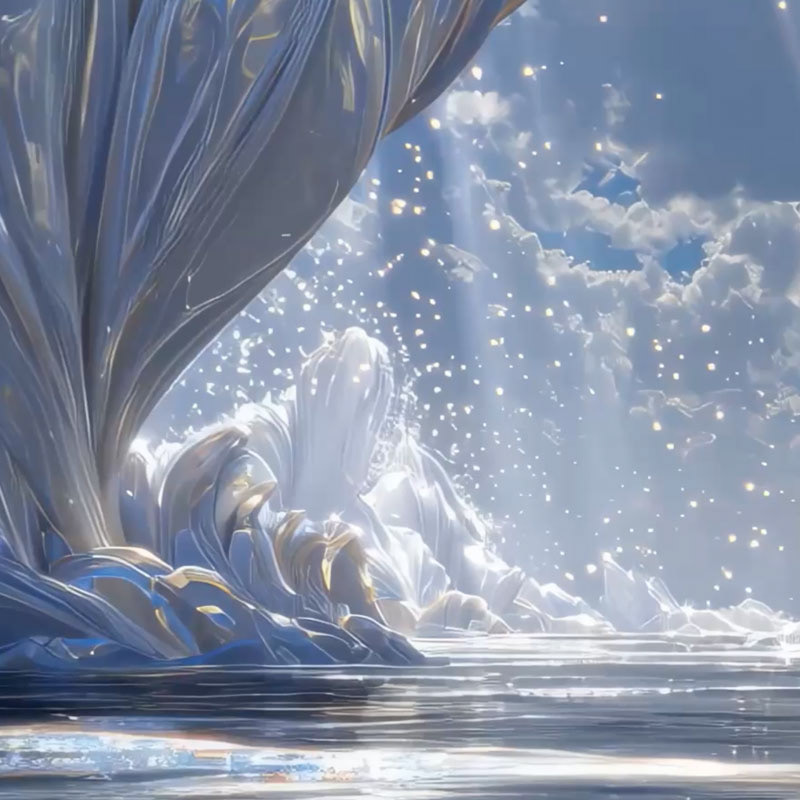
The Climate World: Sensing (with no eyes) (2025)
By Seahee Chang
Single-channel video animation, 4 minutes 28 seconds
This series emerges from The Climate of the World and its “language of senses,” a framework that seeks to reconstruct our communication with nature within a human-centred world where nature is continually consumed and diminished. “Seeing,” “Hearing,” and “Speaking” form three axes perceiving, receiving, and expressing through which the work examines how human senses attune to and resonate with the sensitivities of the natural world. “Seeing” is not merely the reception of visual information, but the point at which the world and the human first make contact. To see is to recognize existence; it is a sense formed in the relationship between light and the eye. In The Climate of the World, seeing is not an act of observing or recording, but a state of standing within the moment when the world reveals itself.
By Seahee Chang
Single-channel video animation, 4 minutes 28 seconds
This series emerges from The Climate of the World and its “language of senses,” a framework that seeks to reconstruct our communication with nature within a human-centred world where nature is continually consumed and diminished. “Seeing,” “Hearing,” and “Speaking” form three axes perceiving, receiving, and expressing through which the work examines how human senses attune to and resonate with the sensitivities of the natural world. “Seeing” is not merely the reception of visual information, but the point at which the world and the human first make contact. To see is to recognize existence; it is a sense formed in the relationship between light and the eye. In The Climate of the World, seeing is not an act of observing or recording, but a state of standing within the moment when the world reveals itself.